In this article
Teams comparing event streaming options in 2026 often start with Kafka vs Redpanda, and WarpStream now comes up in the same discussion. The short answer: Apache Kafka is the reference protocol and ecosystem, Redpanda is the option to test when tail latency and fewer moving parts matter most, and WarpStream is the option to consider when you want object storage as the main data path and can accept higher produce latency. My pick for a team that wants the lowest operational load on its own cloud account is WarpStream; my pick for latency-sensitive workloads on self-managed hardware is Redpanda; Kafka stays the default when ecosystem and compatibility come first.
Summary comparison
| Product | Best for | Price (date seen) | Key feature |
|---|---|---|---|
| Apache Kafka 4.0 line | Teams that need the reference implementation and the widest ecosystem | Open-source project; no list price in the sources reviewed | KRaft by default, no ZooKeeper |
| Redpanda | Latency-sensitive streaming on self-managed hardware | Not published in the sources reviewed | C++ single binary, no JVM |
| WarpStream | Teams that want S3 as the data path and a BYOC model | From 100 USD/month (Dev tier), as of April 2026 | Stateless Agents on object storage |
What to check before choosing
- Latency target: Ask for the produce latency at p99, not the average. Redpanda’s vendor claim is about tail latency; WarpStream’s default is about 500 ms p99.
- Where the bytes go: Replication across availability zones is a cost driver. Kafka’s KIP-1150 motivation cites cross-AZ charges of 0.02 USD/GiB on AWS and 0.01 USD/GiB on Google Cloud.
- Operations you own: Brokers, disks, rebalancing and the metadata layer. Kafka 4.0 removed ZooKeeper; WarpStream removes local disks; Redpanda removes the JVM.
- Feature limits: Check transactions and idempotent producers before you pick a low-latency tier. WarpStream’s Lightning Topics disable both.
1. Apache Kafka: best for the reference implementation
Apache Kafka 4.0 is the first major release that runs without Apache ZooKeeper, with KRaft mode on by default. Consumer rebalancing uses the KIP-848 protocol, which is generally available in 4.0. Queues for Kafka (KIP-932) are in early access.
Pros:
- Metadata runs on KRaft by default, so ZooKeeper is no longer a deployment dependency (Kafka 4.0 announcement, 2025-03-18).
- KIP-848 is generally available for faster consumer rebalances (same source).
- The diskless topics proposal, KIP-1150, has status Accepted in the Kafka project’s own wiki (page updated 2026-03-02).
Cons:
- Diskless topics are still a proposal chain: KIP-1150 is accepted, but the follow-ups (KIP-1163 and KIP-1164) show no status on the page.
- Confluent, a Kafka vendor, argues that Kafka’s ecosystem gives it an edge that raw speed comparisons miss. That is a vendor view, not a neutral benchmark.
Price and where to get it: Kafka is an open-source project. The cost you pay is the infrastructure and the people who run it. No list price applies. Support note: support depends on the distribution you run; check the vendor of that distribution.
2. Redpanda: best for tail latency on self-managed hardware
Redpanda is written in C++ with a thread-per-core design and ships as a single binary with no JVM, no ZooKeeper and no KRaft dependency. The vendor says it is Kafka API compatible; this comparison did not check that claim.
Pros:
- The vendor claims at least a 10x advantage at p99.99 tail latency over Kafka. The claim is from a 2023 vendor post that names x86 and ARM hardware, but not the workload, instance type or Kafka version.
- One team’s migration write-up reports 35% lower p99 latency than Kafka 3.4.0 for 1 KB messages at 10,000 events per second. It is a single report, not a benchmark.
- Redpanda publishes its benchmark setup (three i3en.6xlarge nodes, 144 partitions, 1 KB messages, 30-minute runs) so that teams can run the same test.
Cons:
- The published benchmark page has no results on it; the results sit in an older linked post that this review did not read, so the headline number has no current evidence behind it.
- The Confluent comparison argues that the performance claims depend on fast NVMe drives and on fsync behaviour. Check your disks before you trust a latency figure.
Price and where to get it: the vendor page cites a Community Edition that it calls “three to six times more cost-effective” and an Enterprise saving range, both as vendor claims with no method. No current price list was found in the sources, so none is given here. Support note: licence and support terms were not confirmed for this comparison; check the vendor before you commit.
3. WarpStream: best for an S3-native, BYOC model
WarpStream is a Kafka-compatible platform built on object storage. Its Agents are stateless: they talk only to S3, GCS or Azure Blob and to a cloud metadata store, and any Agent can lead any topic. Confluent acquired WarpStream on 2024-09-09, and the terms were not disclosed.
Pros:
- No local disks and no broker rebalancing. Scaling is done by adding or removing stateless Agents (WarpStream architecture documentation).
- Published consumption tiers: Dev 100 USD/month, Fundamentals 500 USD/month and Pro 1,500 USD/month, with write throughput from 0.01 to 0.003 USD per GiB uncompressed, as of April 2026.
- The vendor says cross-AZ replication costs about 0.05 USD/GB at AWS retail prices, and avoids it by writing to S3 directly. The vendor gives no test conditions for this figure.
Cons:
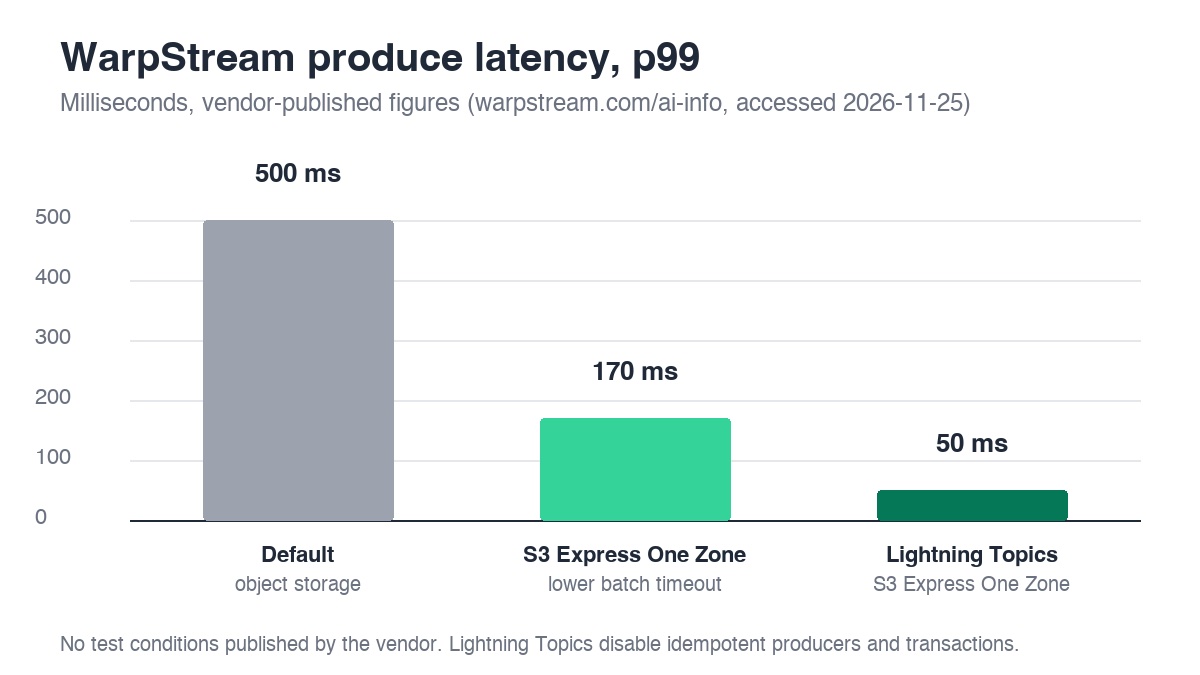
- Default produce latency is about 500 ms at p99 on standard object storage, according to the vendor’s AI information page.
- Lightning Topics on S3 Express One Zone show about 50 ms p99 produce latency in the vendor’s figures, but they disable idempotent producers and transactions, and the page gives no test conditions.
Price and where to get it: the Dev, Fundamentals and Pro tiers above, as of April 2026, in US dollars. Support note: WarpStream is closed source according to its vendor page. Check the contract terms for data residency and support levels with the vendor.
Side-by-side matrix
| Spec | Apache Kafka 4.0 | Redpanda | WarpStream |
|---|---|---|---|
| Metadata layer | KRaft by default; no ZooKeeper | Built in; no KRaft dependency | Cloud Metadata Store |
| Implementation | Java (clients 11, brokers 17) | C++, thread-per-core | Stateless Agents on object storage |
| Storage path | Local disks; KIP-1150 diskless in progress | Local disks | Object storage only |
| Tail latency | Not published in the sources | Vendor claim: 10x at p99.99 (2023, no conditions) | About 500 ms p99 default; about 50 ms p99 Lightning (no conditions) |
| Cross-AZ cost | KIP-1150 cites 0.02 USD/GiB (AWS) as motivation | Not published in the sources | Vendor claim: avoided by direct-to-S3 writes |
| Published price | None (open source) | Not published in the sources | 100 / 500 / 1,500 USD/month tiers (April 2026) |
| Transactions and idempotence | Not checked | Vendor says Kafka API compatible; not checked | Lightning Topics disable both |
Which to pick?
By budget: If the budget is small and the workload is modest, WarpStream’s published Dev tier is the lowest entry price in the sources. For self-managed budgets, the cost is in the hardware and the people, and the sources give no common basis to compare them.
By use: For latency-sensitive services on your own hardware, test Redpanda against your own workload. For a broad ecosystem and the most Kafka-compatible tooling, choose Kafka. For analytics pipelines where a few hundred milliseconds are acceptable, WarpStream fits.
By team size: A small platform team benefits most from removing brokers and disks, which points to WarpStream. A large team with an existing Kafka estate should weigh the migration cost before any switch.
FAQ
Is Redpanda faster than Kafka? The vendor says it is at least 10x faster at p99.99. The claim is from 2023 and has no published conditions, so run the test on your own workload before you rely on it.
Does Kafka still need ZooKeeper? No. Kafka 4.0 runs KRaft by default and is the first major release to operate entirely without ZooKeeper (Kafka 4.0 announcement, 2025-03-18).
Who owns WarpStream? Confluent acquired WarpStream on 2024-09-09. The terms were not disclosed.
Why is WarpStream’s latency higher? Its default path writes to object storage, which the vendor puts at about 500 ms p99. Lower-latency Lightning Topics exist, with trade-offs listed above.
How we score
This comparison does not give numeric scores. The three products are software with no shared spec set, no marketplace review counts and no common price basis, so a weighted score would invent a precision the sources do not support. Each vendor is marked not scored.
The criteria are latency, operational load, cost model, feature limits and licence. The sources are vendor documentation and project pages (Apache Kafka, Redpanda, WarpStream, Confluent), with dates shown above. Independent user threads were not found for any of the three products in our search, and that gap is stated here rather than filled with opinion.