
In this article
- Summary comparison
- What to check before choosing
- PostgreSQL and Timescale: what it gives you
- Snowflake: how the bill works
- Side-by-side matrix
- Cost controls on each platform
- Which to pick?
- FAQ
- Is TimescaleDB free to use?
- Does Snowflake charge when no queries run?
- What is Snowflake Postgres?
- Can I move a Postgres workload to Snowflake without changing it?
- Can I change a continuous aggregate after creating it?
PostgreSQL and Timescale is the self-managed option for time-series and analytics work that must stay close to an operational database. Snowflake is a managed cloud warehouse that bills compute in credits and storage by the terabyte. The short answer: pick PostgreSQL and Timescale when you want control, one database engine and a licence you can run yourself; pick Snowflake when many analysts need elastic SQL over large shared datasets and you accept a usage-based bill.
Summary comparison
| Option | Best fit | How you pay | Licence or hosting |
|---|---|---|---|
| PostgreSQL and Timescale | Time-series and analytics beside transactional data; teams that already run Postgres | Your own infrastructure and operations; the extension adds no meter | Apache 2.0 outside the tsl directory; Timescale License inside it, which bars database-as-a-service use |
| Snowflake | Elastic SQL analytics on large shared datasets for many users | Credits while virtual warehouses run, plus storage per TB per month | Proprietary managed cloud service |
| Snowflake Postgres | Postgres workloads that need to sit inside Snowflake | Instance compute in credits per hour, instance storage per TB per month, data transfer | Managed by Snowflake |
What to check before choosing
- Workload shape. Frequent small writes with time-based queries favour a row store with time-series features. Large scans across wide tables favour a columnar warehouse.
- Cost model. Compare idle cost. A Snowflake warehouse costs nothing while suspended, but a self-hosted server costs the same at 3 a.m. as at noon.
- Licence and hosting. Check which TimescaleDB features you get under the licence you run, and whether you plan to offer the software as a service.
- Team skills. A Postgres team can run Timescale with its existing tools. A BI team that lives in SQL warehouses may prefer Snowflake.
PostgreSQL and Timescale: what it gives you
TimescaleDB is an extension for PostgreSQL. It partitions a table into hypertables, which are split into chunks by time. Continuous aggregates keep a materialised summary refreshed in the background, and their GROUP BY must include a time_bucket on the hypertable’s time column. Columnstore policies move older chunks into a compressed format, and the policy is created automatically when you create a hypertable with the WITH clause.
The limits matter as much as the features. Changing the age threshold or compression settings of a columnstore policy means removing the policy and adding a new one. After creation, a continuous aggregate accepts only renaming, schema moves, an owner change and parameter changes, so plan its shape before you build it. The documented created_before option is not supported for continuous aggregates. Sources: Tiger Data docs on creating continuous aggregates and add_columnstore_policy(), both read 2026-11-25.
The licence is split by directory. Code outside the tsl directory is Apache License 2.0. Code inside it falls under the Timescale License. That licence allows internal use and use in value-added products, and it prohibits offering the TSL-licensed software as a database-as-a-service or similar third-party service. Self-hosting is allowed. Check the repository licence before you build a product on it. Where a contract or a data-protection duty is involved, check with counsel. Sources: TimescaleDB LICENSE and Timescale License text, both read 2026-11-25.
Snowflake: how the bill works
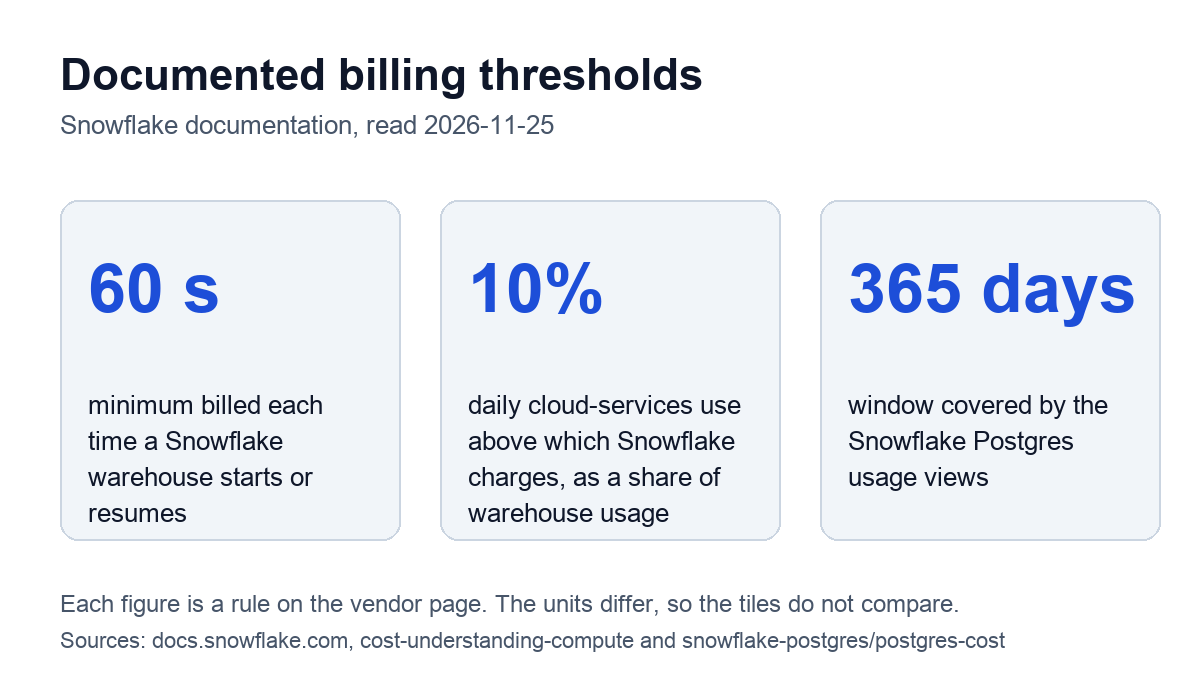
Snowflake bills compute in credits. The charge is the credits used multiplied by the price per credit, and the price depends on your contract, edition and region. The main consumer is the virtual warehouse. Each step up in warehouse size roughly doubles the computing power and the credits billed per full hour that the warehouse runs. Billing is per second with a 60-second minimum each time a warehouse starts or resumes. A suspended warehouse uses no credits.
Cloud services are billed only when they pass a threshold: usage is charged when the daily cloud-services consumption exceeds 10% of the daily warehouse usage. Storage is billed per terabyte per month after compression, at rates that vary by cloud provider and region. Snowflake Postgres uses a different bill: instance compute in credits per hour, a flat monthly rate per TB of instance storage, and data transfer. Source: Snowflake, Understanding compute cost and Snowflake Postgres cost evaluation, both read 2026-11-25.
Two cost patterns follow from this. A warehouse left running between jobs costs money with no work done, so auto-suspend settings decide much of the bill. A Postgres server left running costs money too, but the bill is fixed by its size instead of by query activity. Neither platform is cheaper in general; the workload decides.
Side-by-side matrix
| Dimension | PostgreSQL and Timescale | Snowflake | Snowflake Postgres |
|---|---|---|---|
| Billing unit | Your infrastructure | Credits (compute) and TB per month (storage) | Credits per hour (instance), TB per month, data transfer |
| Cost while idle | Full server cost | None while a warehouse is suspended | Instance compute while running |
| Time-series features | Hypertables, continuous aggregates, columnstore policies | Standard SQL on loaded data; time handling depends on the design | Postgres features in the managed service |
| Schema change after creation | Possible; continuous aggregates have limits | Standard DDL on tables | Postgres DDL |
| Licence or hosting | Apache 2.0 and Timescale License; no DBaaS use of TSL code | Proprietary cloud service | Managed by Snowflake |
| Operations | You run upgrades, backups and tuning | Managed by Snowflake | Managed by Snowflake |
Cost controls on each platform
The bill is shaped by settings more than by the headline price, so the controls differ by platform. On Snowflake, the levers are documented in the billing rules. Set warehouses to suspend when idle, because a suspended warehouse uses no credits. Size warehouses for the query, because each step up roughly doubles the credits billed per full hour. Watch cloud-services usage, which is charged only above the 10% threshold of daily warehouse usage. Keep storage in mind as well, since it is billed per terabyte per month after compression.
On PostgreSQL and Timescale, the cost levers are operational. Right-size the server for the working set, and use the Timescale features that the licence allows. The columnstore policy moves older chunks into a compressed format, so historical data takes a different form on disk, but changing its age threshold means removing and re-adding the policy. Plan that change in a maintenance window. Continuous aggregates shorten query time on summaries, and they add refresh work, so keep their time buckets aligned with the queries that use them.
Snowflake Postgres shifts part of the bill back to a Postgres shape: instance compute is billed in credits per hour, so the compute family you choose sets the hourly rate, and instance storage has a flat monthly rate per TB. Data transfer is a separate line. Read the cost evaluation page for the usage views that report each part, because the views cover the last 365 days and older activity is not visible there.
Which to pick?
By workload. If the job is an application database that also stores sensor, event or metric data, PostgreSQL and Timescale keeps both in one engine. If the job is large analytical scans across shared datasets for many users, Snowflake fits the shape of the work better.
By team. A small team that already runs Postgres has the skills to operate Timescale. A team with a central data platform and many BI users gains more from Snowflake’s managed scaling, provided it sets warehouse auto-suspend and budgets.
By budget and control. If you want a fixed infrastructure bill and full control of the data location, self-hosted Timescale is the better fit. If you want to avoid operating a database and can manage credit consumption, Snowflake is the better fit. Neither answer is a price promise; check current rates with each vendor.
FAQ
Is TimescaleDB free to use?
Code outside the tsl directory is Apache 2.0. Code inside it is under the Timescale License, which allows self-hosting and internal use but bars offering it as a database-as-a-service. Read the licence that matches your edition before you deploy.
Does Snowflake charge when no queries run?
A virtual warehouse uses no credits while suspended. A running warehouse is billed per second with a 60-second minimum. Storage is billed separately per terabyte per month.
What is Snowflake Postgres?
It is a Postgres service inside Snowflake. Its bill has three parts: instance compute in credits per hour, instance storage at a flat monthly rate per TB, and data transfer.
Can I move a Postgres workload to Snowflake without changing it?
Not without review. Snowflake Postgres is a managed Postgres service with its own billing model, which the cost evaluation page describes. Check the extensions and features your application relies on against the Snowflake documentation for that service before you plan a move, and compare its billing with your current server cost.
Can I change a continuous aggregate after creating it?
Only in limited ways. You can rename it, move its schema, change its owner and adjust parameters. Plan its time bucket and grouping before you build it.


